

Mobile devices are essential tools for today’s organizations. Across retail, healthcare, and transportation and logistics industries, smartphones (81%), tablets (79%) and rugged devices are used daily. They support customer interactions, data collection, reporting and more. As mobile device use continues to grow, so does the need for strong mobile fleet management software.
Mobile fleet management helps organizations monitor and manage large groups of devices from a single platform. Teams gain real-time visibility and can deliver useful insights that help teams act early. This makes it easier to lower costs, improve efficiency and keep operations running smoothly.
In this blog, we’ll explore five advantages of mobile fleet management software and explain why it’s essential for organizations of all sizes.
Key Takeaways
-
Mobile fleet management centralizes control of smartphones, tablets and rugged devices.
-
Real-time visibility improves decision-making and efficiency.
-
Strong security and compliance reduce the risk of data breaches.
-
Proactive fleet mobile maintenance extends device lifecycles and reduces downtime.
-
Automation reduces administrative work and human error.
What Is Mobile Fleet Management
Mobile fleet management refers to the processes and technology used to manage and monitor mobile devices across an organization. Using centralized software, organizations can remotely configure devices, enforce policies, monitor performance and fix issues when they arise. The main goals are to increase productivity, control costs and find potential problems early so they don’t interrupt work.
Who Needs Mobile Fleet Management Software?
Mobile fleet management is essential for organizations that rely on large numbers of mobile devices to keep daily operations running smoothly. Industries such as retail, healthcare, field services, and transportation and logistics depend on smartphones, tablets and rugged devices to support frontline and mobile workers.
Because many of these devices are shared, IT teams need a clear view of their devices and the ability to manage them to keep them secure, up to date and functioning properly. At the same time, operations leaders can use mobile fleet management software to see how devices are being used, to boost productivity and to make sure employees always have access to the tools they need.
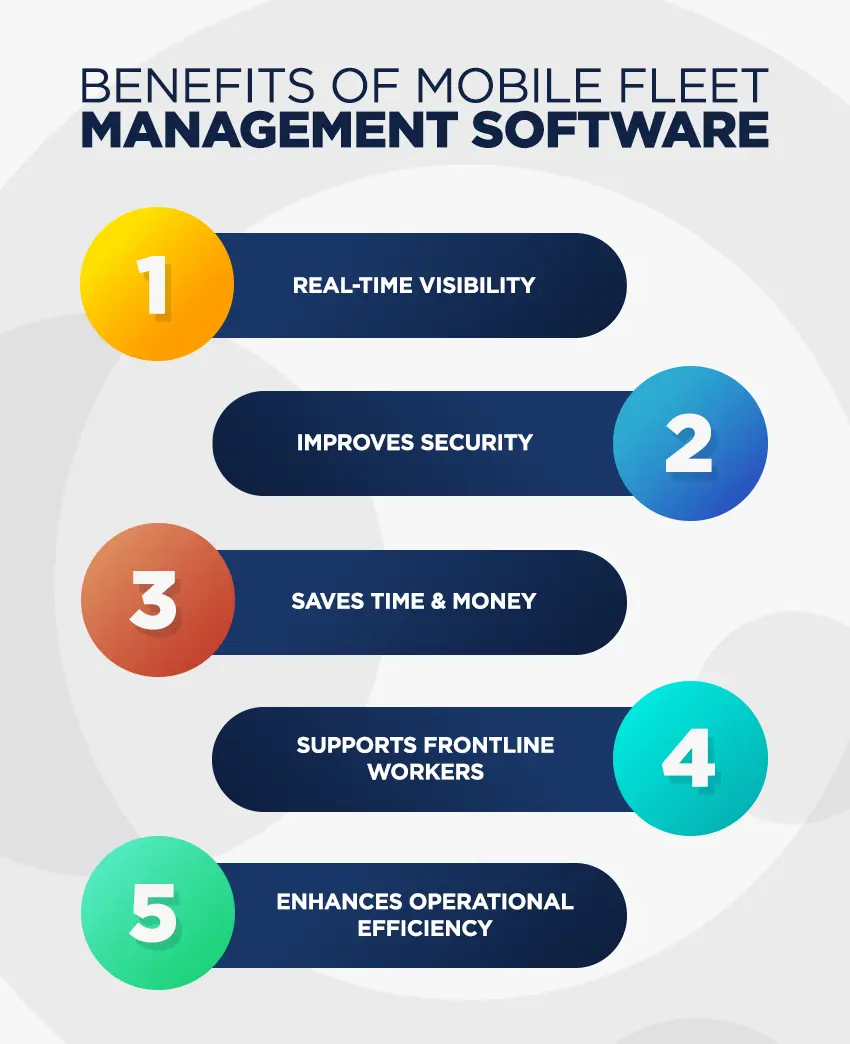
Any business with mobile workers can benefit from the following five advantages:
What Are the Benefits of Mobile Fleet Management Software?
#1: Real-Time Visibility Across Your Mobile Device Fleet
One of the biggest benefits of mobile fleet management software is real-time visibility into every device. From a single dashboard, teams can view device status, connectivity, location and usage patterns.
This visibility helps organizations:
-
View underperforming or inactive devices
-
Spot patterns that impact productivity or reliability
-
Make faster, data-driven decisions
These insights go beyond basic device monitoring to actively support mobile fleet maintenance. They show teams when to take action and where attention is needed most. For more information about why total visibility matters, check out this blog.
#2: Improve the Security of Your Mobile Devices
Every mobile device can become a security risk if it is lost, misused or outdated. Mobile fleet management tools help reduce this risk by applying the same security policies on every device.
With the right solution, organizations can:
-
Limit access to approved apps and features
-
Protect sensitive data through strong policies
-
Remotely lock or wipe devices when needed
Ongoing monitoring also lets teams identify risky activity early. This helps keep devices secure, lower the amount of incidents and meet industry regulations.
#3: Save Time & Money with Proactive Management
Managing a large mobile fleet manually can be costly and time-consuming. Mobile fleet management software simplifies this by automating routine tasks like device setup, updates and maintenance scheduling.
From a cost perspective, finding problems early when managing devices helps organizations:
-
Reduce downtime caused by device failures
-
Make sure devices last longer
-
Avoid unnecessary replacements or emergency repairs
By fixing issues before they get worse, organizations can save time and money while also making sure employees have reliable devices. To discover more about Windows or Android device management specifically, check out this blog.
#4: Provide Frontline & Field Workers with Better Support
Mobile devices are a daily tool for 81% of frontline workers, making reliability critical. When devices go down, downtime can cost up to $9,000 per minute in lost profits or compliance issues.
Mobile fleet management software supports the people using these devices. With real-time insights into device health, connectivity and configuration, issues can be avoided before they interrupt work. As a result, frontline workers can stay focused on their tasks.
This leads to:
-
Less downtime and frustration
-
Faster issue resolution through remote support
-
Higher productivity and user satisfaction
Read this blog to learn more about how this solution can resolve problems faster.
#5: Enhance Operational Efficiency with Automated Processes
Manual device management tasks are not only time-consuming – they are no longer necessary. Mobile fleet management software can automate processes like device enrollment, updates, compliance checks and routine maintenance.
With only 31% of organizations currently using automation in their workflows, there is significant room for improvement. Automation helps make workflows simpler and faster, reduce administrative work and decrease human error. This allows teams to be more efficient and productive.
Mobile Fleet Management vs. Manual Device Management
The way organizations manage devices has a direct impact on costs, security and efficiency. Manual device management may work for small teams, but it quickly becomes slow and likely leads to errors as the number of devices grow.
The chart below compares manual device management with mobile fleet management, showing why a centralized, automated approach is better suited for modern, enterprise operations.
Manual Fleet Management
Mobile Fleet Management
Cost
-
High, long-term costs due to labor-intensive processes
-
Frequent device downtime and replacement costs
-
Lower total cost of ownership (TCO) with automated processes
-
Fewer device failures and faster issue resolution
Time
-
Time-consuming manual setup, updates and troubleshooting
-
Requires hands-on IT involvement for every device
-
Centralized management saves hours for IT teams
-
Remote provisioning and updates
Security
-
Inconsistent security policies across devices
-
Slow response times to lost or stolen devices
-
Role-based security policies
-
Instant remote lock, wipe and compliance monitoring
Scalability
-
Difficult to manage as mobile device fleets grow
-
More devices mean more manual effort
-
Easily scale mobile device fleets from tens to hundreds or thousands
-
New devices can be deployed and managed instantly and consistently
Manual Fleet Management
Cost
-
High, long-term costs due to labor-intensive processes
-
Frequent device downtime and replacement costs
Time
-
Time-consuming manual setup, updates and troubleshooting
-
Requires hands-on IT involvement for every device
Security
-
Inconsistent security policies across devices
-
Slow response times to lost or stolen devices
Scalability
-
Difficult to manage as mobile device fleets grow
-
More devices mean more manual effort
Mobile Fleet Management
Cost
-
Lower total cost of ownership (TCO) with automated processes
-
Fewer device failures and faster issue resolution
Time
-
Centralized management saves hours for IT teams
-
Remote provisioning and updates
Security
-
Role-based security policies
-
Instant remote lock, wipe and compliance monitoring
Scalability
-
Easily scale mobile device fleets from tens to hundreds or thousands
-
New devices can be deployed and managed instantly and consistently
Putting It All Together
When you combine all five advantages, it becomes clear that mobile fleet management is more than just an IT tool. It helps teams work faster, see device issues clearly and stay in control.