


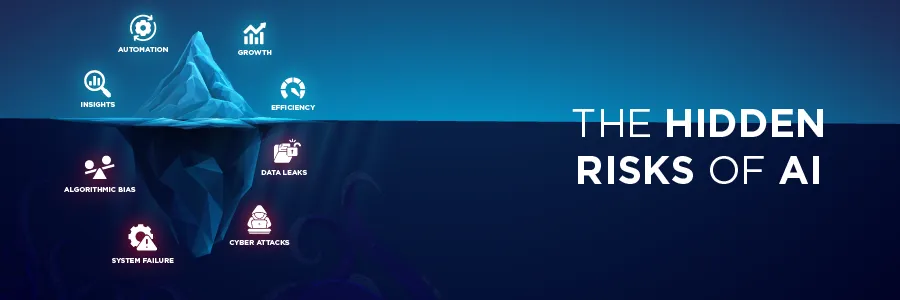
When times are uncertain, organizations look for stability. In moments where relevance, control or survival feel at risk, even imperfect systems can feel reassuring. History shows that during periods of disruption, businesses, people, and societies often accept tradeoffs and incomplete solutions simply because they provide a sense of order and direction.
From the Industrial Revolution to the 2008 financial crisis, moments of transformation have pushed organizations to make difficult choices. Artificial intelligence (AI) is the latest example. As economic, operational and technological uncertainty grows, AI has come to represent both real opportunity and the illusion of control in an increasingly complex world.
This blog isn't a plan or a how-to guide. Instead, it offers a way to think about the hidden risks of rapid AI adoption and the operational realities required to manage AI responsibly.
Key Takeaways
AI introduces new security, privacy and operational risks that traditional IT frameworks aren't built to handle.
Cybercriminals are increasingly targeting and using AI to scale and improve attacks.
AI failures can have real‑world consequences, from patient safety risks to financial loss.
The benefits of AI remain significant but only when paired with strong risk management and human oversight.
Understanding the Risks of AI in Business
Today, AI is being adopted at an extraordinary speed. Organizations are under growing pressure to act because of competition, economic uncertainty and rapid technological change. As a result, many businesses are embracing AI faster than they can manage it. And that urgency is where risk begins.
The Promises & Pressures of AI Adoption
AI promises efficiency, insight and scale. But when adoption outpaces oversight, the dangers become harder to see – and far more costly to fix.
AI is already changing labor markets and straining global infrastructure, including energy and data centers. Yet, many of the biggest risks appear much closer to the business, within day‑to‑day operations and frontline environments. As AI becomes embedded across organizations, understanding and managing AI risk is no longer optional.
The First Challenge Organizations Face
Overconfidence. Many organizations assume AI outputs are accurate or unbiased, even when the data behind them is incomplete or flawed. Without clear governance and human oversight, AI systems can reinforce errors at scale.
This challenge becomes even more pronounced in operational settings, such as logistics, retail or field services, where AI insights influence real‑world actions.
What Are the Risks of AI?
Most AI risks typically fall into four categories:
Cybersecurity
Data privacy and regulatory risk
Biased decision‑making
Operational and supply chain disruption
In many cases, the risk grows in distributed environments where AI directly interacts with mobile devices, frontline workers and remote operations.
Do the Benefits of AI Outweigh the Risks?
In many cases, yes. AI improves efficiency and responsiveness. But these benefits last only when organizations manage AI risk responsibly. Without proper controls, the downsides can outweigh the gains.
Major AI Security Risks & Threats
Threat | Core Risks | Potential Business Impact |
|---|---|---|
AI‑Enabled Cybersecurity Threats | Attackers use AI to automate and scale cyberattacks, while also leveraging it to evade detection. | More breaches, faster attacks, operational disruption, reputational damage |
Operational Edge Vulnerabilities | Mobile devices, endpoints and connected systems can introduce vulnerabilities or feed compromised data into AI workflows. | Incorrect AI outputs, weakened security, hidden exposure across frontline operations |
Data Privacy & Compliance Risks | AI systems rely on large volumes of data collected across distributed environments. | Regulatory fines, legal penalties, loss of customer trust, compliance failures |
Decision-Making Failures | Errors in AI-related decision-making often stem from insufficient testing, biased inputs or a lack of human oversight. | Financial loss, safety risks, long‑term reputational damage |
AI & Cybersecurity Threats
Artificial intelligence is now a tool for both attackers and defenders. Criminals use AI to automate phishing, evade detection and scale attacks faster. At the same time, defenders rely on AI to identify anomalies, raising the stakes when systems malfunction or are misused.
Many AI security risks originate at the operational edge, where poorly managed endpoints, mobile devices and connected systems introduce vulnerabilities or feed compromised data into workflows.
Data Privacy & Compliance Risks
AI depends on large amounts of data. When that information is collected across mobile or remote environments, organizations must ensure that data is handled correctly and aligns with evolving regulations.
Without a clear understanding of where data originates and how it flows, privacy and compliance risks increase.
Decision-Making Breakdowns
AI-related errors often come from insufficient testing, biased inputs or a lack of human oversight. Without due diligence, these outcomes can damage trust, increase costs and, in some cases, compromise safety.
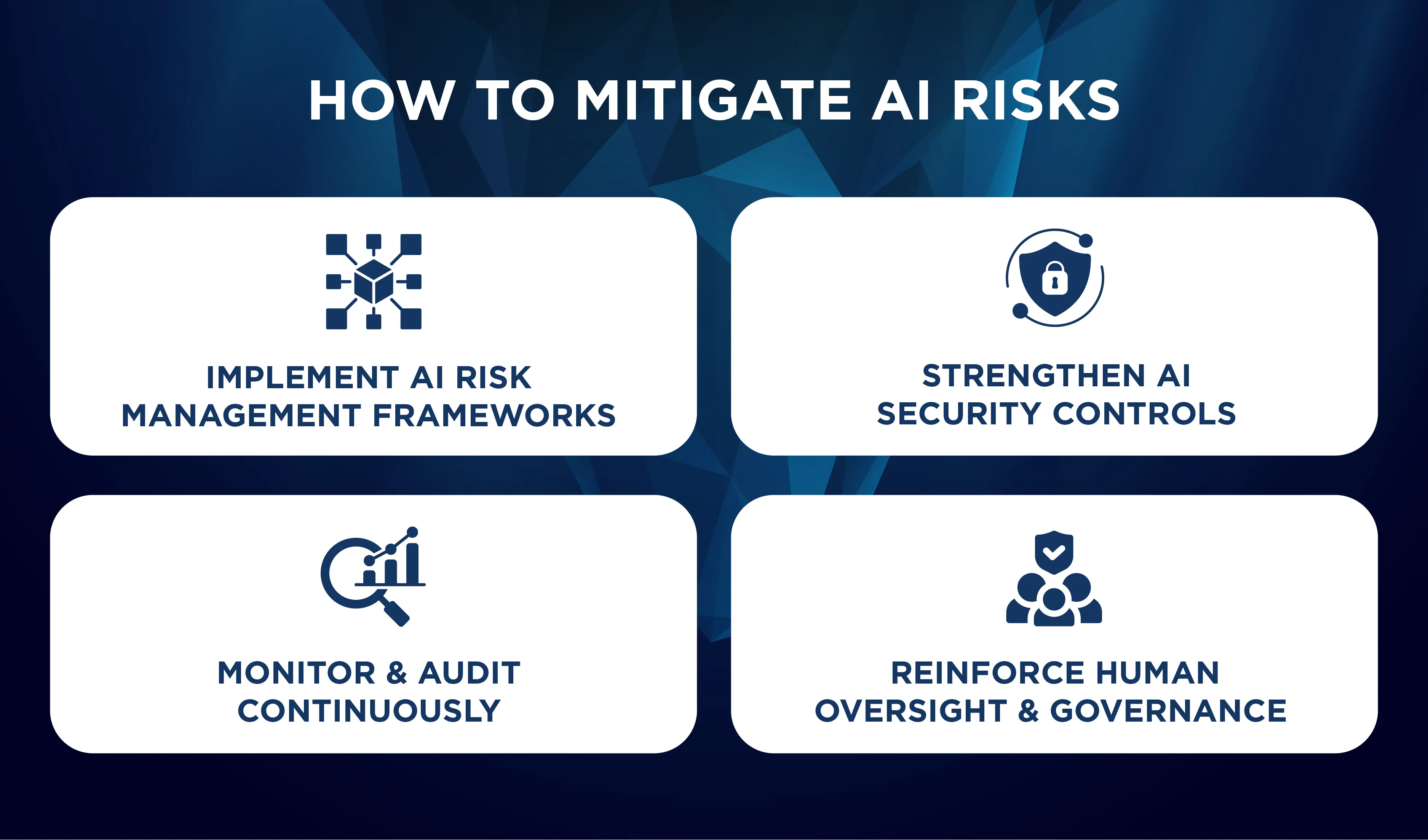
Managing AI risk doesn't mean slowing innovation. It means putting the right foundations in place so AI can be used responsibly, securely and at scale.
Implement AI Risk Management Frameworks
Good AI governance goes beyond policy documents. Organizations need clear visibility into how AI interacts with data, devices and workflows across the business.
AI risk management should be embedded into daily operations rather than simply addressed at deployment.
Strengthen AI Security Controls
AI security must extend to endpoints and connected systems, as they all play a role in shaping AI behavior and exposure.
Enhanced configuration, strong access controls and real-time monitoring are critical to reducing security risks.
Monitor & Audit Continuously
AI constantly evolves. Ongoing monitoring and auditing helps organizations catch problems early, before they become major operational issues.
Reinforce Human Oversight & Governance
The strongest AI strategies should support human judgment, not replace it. Clear accountability, ownership and escalation paths are critical.
Human oversight provides the context, ethics and situational awareness that AI alone cannot replicate.
Bringing Clarity to AI in an Uncertain World
AI is no longer a future consideration. When uncertainty arises, the instinct to embrace something – anything – can be powerful when ambiguity feels uncomfortable. History shows us that flawed systems are often adopted because they reduce anxiety, not because they are right.
Organizations that succeed will focus on three key areas:
Visibility
Control
Governance, especially where AI meets real‑world operations
By prioritizing these fundamentals, businesses can ensure AI becomes a source of clarity rather than a false sense of certainty. Not a replacement for judgment, but a tool that supports better, more informed decisions in an increasingly uncertain world.
To learn how SOTI helps organizations gain the visibility and control of their mobile-first operations, contact us today.
FAQ
What are the benefits of AI?
AI can improve efficiency, speed and insight across an organization. When applied thoughtfully, it helps them automate repetitive tasks, analyze large volumes of data more effectively, and respond faster to changing conditions.
What is the biggest problem of AI?
The biggest challenge organizations face with AI is over‑reliance on automated decisions without fully understanding how those decisions are made. Many teams assume AI outputs are accurate, objective or complete, even when the underlying data is limited, biased or outdated.
What are the potential risks of AI?
AI introduces several risks that organizations must actively manage. Cybersecurity threats increase as attackers use AI to automate and scale attacks. Data privacy and regulatory risks grow as AI systems rely on large volumes of information collected across distributed environments.
In addition, biased or flawed inputs can lead to poor decision‑making, while operational failures can disrupt supply chains, frontline workflows or critical services.