Android for Work Kiosk Mode |
Kiosk Mode replaces the standard device home screen with a customizable home screen. Users have access only to authorized applications and websites, and are prevented from accessing all other applications and device controls.
Note:
Kiosk Mode is only supported on Android managed devices running Android Marshmallow (6.0) and later.
By enabling kiosk mode on devices, organizations can minimize the risk of unauthorized persons accessing information on their mobile devices. Administrators can control exactly which programs device users are allowed to run, and which websites they are allowed to visit. This decreases the amount of down-time caused by users changing settings that may adversely affect the operation of the device or application software, and also decreases support costs. MobiControl allows running the mobile devices in a kiosk mode with a read-only access to provide critical information to the end users, without giving them access to change the settings.
When you create a Kiosk Mode profile configuration, you must also create an Authentication profile configuration with a Device Administrator Password configured. This allows you to dismiss the Kiosk Mode menu directly on the device. You can also choose to configure a User Password Policy. If a user password policy is not defined, device users can access the Kiosk Mode menu immediately after turning on the device. If a user password policy is defined, then device users must enter the password to access the Kiosk Mode menu.
Dismissing Kiosk Mode from Devices
Once activated, Kiosk Mode mode can be disabled in two different ways: you can revoke the Kiosk Mode profile configuration or you can disable it directly from the device. On a device with Kiosk Mode enabled, you can access the Administrator menu by swiping up from the bottom of the screen or pressing the back button of the device. Enter the administrator password specified in the Authentication profile configuration associated with the Kiosk Mode profile configuration.
MobiControl also offers an alternative to the default Kiosk method. Activty Suppression is a 'polling-based' method that monitors the device for unapproved activities and moves them to the background where the device user cannot access them. You can change the Kiosk method from within the Advanced menu in the Kiosk Mode dialog box.
To configure kiosk mode settings for a device or group of devices, select Kiosk in the Add Profile dialog box. Make sure you have Android for Work selected as the Type of Android+ profile.
| Field Name | Description |
|---|---|
| Device Control | The device control menu is a list of programs and websites to which the user has access. There are pre-configured HTML menu templates that can be edited or applied to the menu, and an option to enable or disable the launching of a menu item with keyboard shortcuts. Please see the Device Control Menu section below for details. |
| HTML menu template | Select a menu template from the drop-down list. Please see the Templates section below or the Customizing Android for Work Kiosk Mode Menu Templates page for more information. |
 Tip:
Tip:
- If you link to a search engine the end user will gain full access to the Internet.
Device Control Menu
Use the New button to add menu items. Each entry consists of a user-friendly name and a complete file path to the executable,
.lnk shortcut file, .cmd script file, or website address (URL). To adjust the position of the menu items, use the
Move Up and Move Down buttons.
| Field Name | Description |
|---|---|
| Display Name | This is the displayed name of the menu item that will appear on the device. |
| Package Name or Script File or URL |
This is the path for the web address, or Package ID (Bundle Identifier) on the device. For instance, the Package ID (Bundle Identifier) for Google Maps is
|
| Image (optional) |
If you wish to replace an image that had been previously imported, upload the new graphic file, maintaining the same file name as the old one. You will be asked to confirm the overwrite of the old file. Click Yes, and the new image will be in effect. This is the name of the image file that you want to display in the kiosk mode menu with this menu entry. By selecting the image in this dialog box, it will be automatically delivered to the device along with the Kiosk Mode configuration. Select an image from the drop-down list, or click the image to select an image from your desktop computer. In order to display this image in the kiosk mode menu, it is necessary for the HTML template to have a special |
| Use Application Icon | Use the application icon in the kiosk. In order to display this image in the Kiosk menu, it is necessary for the HTML template to have a special <MCEXEIconN>
tag. Please see the Customizing Android for Work Kiosk Mode Menu Templates page for instructions on how to make this image appear in the Kiosk Mode menu. |
| Launch automatically on startup | When this option is checked, the selected program will be automatically executed on startup (i.e. after a soft reset, or restart of the kiosk mode process). |
| Enable Single App Mode | When this option is selected, the device will launch directly into the app, and device functionality will be limited to that application. Only one menu item within the profile configuration may have Single App Mode enabled.
Note: The Launch automatically on start-up option must be enabled to use this option. |
 Note:
Note: 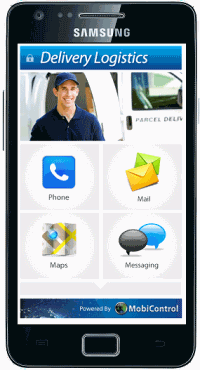
Templates
The kiosk program menu is displayed as an HTML web page to the user. The Template drop-down box allows you to select an HTML template from a list of built in templates and your own customized templates.
You can easily create a customized kiosk template by copying an existing template and directly modifying HTML code in the built-in Kiosk Mode Menu Template Editor available in MobiControl. (Please see the Customizing Android for Work Kiosk Mode Menu Templates page.) You can also use your favorite HTML editor. When editing the HTML file, be sure to preserve the special MobiControl Menu tags. These special tags are automatically replaced with the appropriate Program Menu entries by MobiControl.
Once you have selected the desired template and clicked the OK button, MobiControl will merge the menu items that you have configured with the selected template and generate a custom HTML menu page.
For further assistance, please contact us.
Advanced
The Advanced button opens a new dialog box that allows you to change the Kiosk method and hide the floating home button.
| Field Name | Description |
|---|---|
| Kiosk Method: Activty Suppression | When enabled, the default Kiosk mode method is replaced with a 'polling-based' method that prevents device users from accessing unauthorized applications. Activity Suppression monitors the devices for unapproved activities in the foreground and moves them to the background where the device user cannot access them. |
| Status Bar: Disable Status Bar Expansion | When enabled, the device user will not be able to pull down to expand the status bar of their device while Activity Suppression Kiosk Mode is enabled.
Note: This option is only available when Activity Suppression is selected as the Kiosk Method. |
| Home Button: Hide Floating Home Button | When enabled, the home button that normally floats on the Kiosk Mode home screen is hidden. |